 Kyndle
 How Does Social Media Management Work for Small Businesses?
How does social media management work for small businesses? The 5-step loop, what it includes, hours it takes, and how AI keeps it consistent. Learn more.
Social media management works as a repeatable monthly loop: set a goal, create content, schedule it consistently, engage with your audience, then measure what drives leads and refine. For a small business in Lansing, that means turning random posting into a system, so your brand shows up reliably and turns local followers into paying customers.
If you have ever wondered what a social media manager actually does all day, this guide breaks it down end to end. We will walk through the full process step by step, show how it works for a small business with limited time, explain the modern AI-assisted approach that keeps it sustainable, and look at what it really takes to get leads in a local market like Lansing. By the end you will know exactly what good social media management looks like, whether you plan to do it yourself or hire help.
What does social media management actually include?
Social media management is the full process of running a brand’s social presence, from planning and posting to engagement, analytics, and reporting. It is not just hitting publish. It covers strategy, content creation, scheduling, community management, and measurement, all working together so your accounts move the business forward instead of sitting idle.
Think of it as five jobs that feed each other. Skip one and the whole thing wobbles. Post without a strategy and you talk to the wrong people. Create content but never schedule it and you go quiet the first busy week. Schedule posts but ignore comments and you leave warm leads hanging. The work only pays off when all five run together as a loop.
The five core pillars
- Strategy: your goal, target audience, chosen platforms, and content themes.
- Content creation: graphics, captions, photos, and short-form video.
- Scheduling: a consistent calendar so posts go out on time, every week.
- Engagement: replying to comments, direct messages, and reviews.
- Analytics: tracking reach, engagement, and leads, then adjusting.
Why it matters for a small business
Social media is now where a huge share of buying decisions begin. Around 5.2 billion people use social platforms worldwide, and most of them research businesses there before they ever call. According to Sprout Social’s research, social media now shapes buying decisions at every stage. The numbers below are why a quiet or messy account quietly costs you customers.
How does the process work step by step?
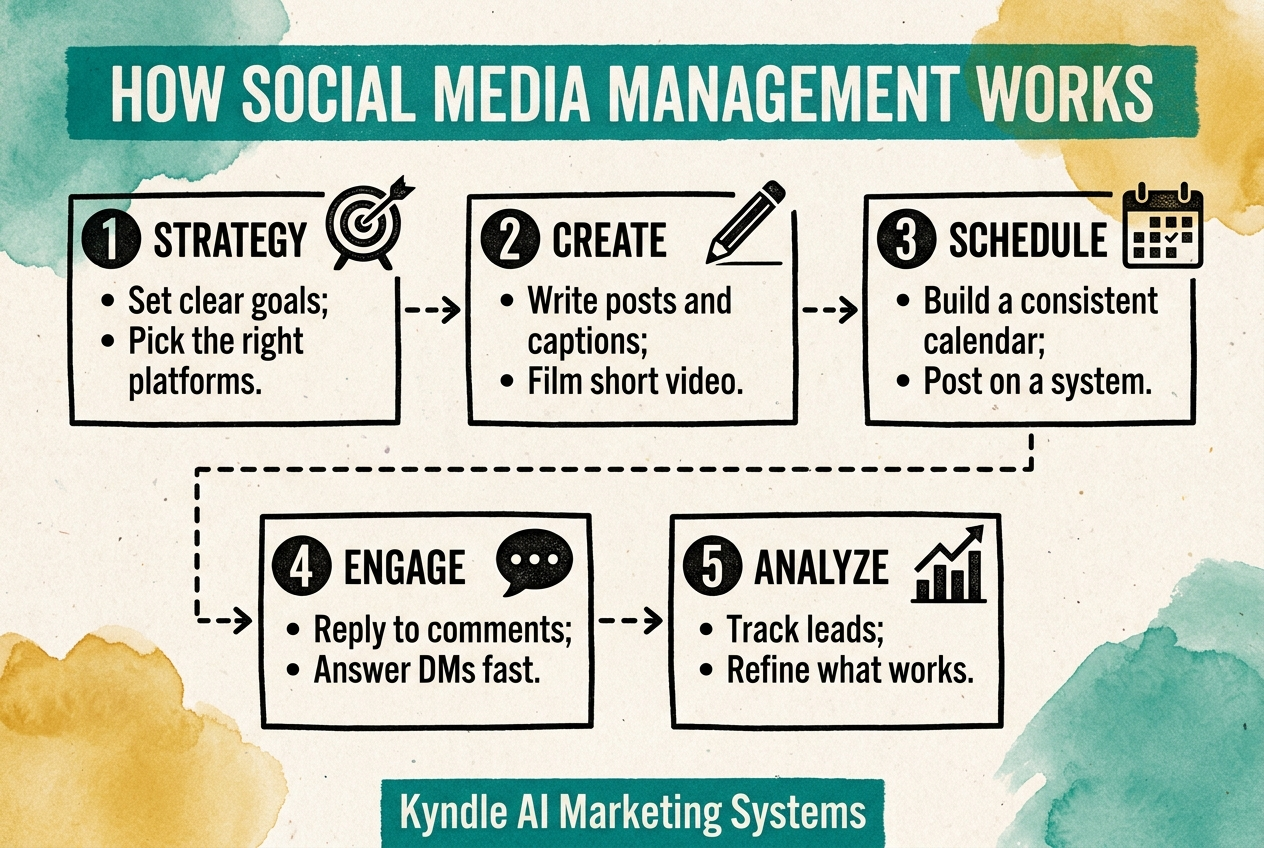
The process runs as a five-step loop you repeat every month: strategy, create, schedule, engage, analyze. Each cycle teaches you what your audience responds to, so the next cycle gets sharper. That feedback loop is the whole point. It is how social media compounds over time instead of starting from zero every week.
Step 1: Strategy
Everything starts with a goal. Not “get more followers,” but something tied to revenue, like booked calls, quote requests, or foot traffic. A simple way to frame it is the SMART approach: specific, measurable, achievable, relevant, and time-bound. “Book 10 new strategy calls a month from Instagram by fall” is a goal you can actually steer toward.
Next, get clear on who you serve and where they spend time. You do not need to be on every platform. Pick one or two where your customers already are. A home service business in Lansing usually finds its audience on Facebook and Instagram. A B2B consultant may lean on LinkedIn. Picking fewer platforms and doing them well beats spreading yourself thin across five.
Step 2: Create
Once you know the goal and the audience, you build content. The strongest accounts mix a few content types instead of posting the same thing on repeat. A reliable formula is to rotate educational posts that answer real customer questions, proof posts like reviews and before-and-after results, and personality posts that show the humans behind the business. Short-form video carries the most reach right now, so plan for it.
This is also where your brand voice lives. A clear, consistent voice makes your content recognizable and easier to produce, because you are not reinventing the tone every time. Write down a few rules for how your brand sounds, then create against them.
Step 3: Schedule
Consistency is the single biggest predictor of whether social media works, and a calendar is what protects it. Instead of posting when you remember, you batch content ahead of time and load it into a scheduler so it goes out on a steady cadence. Batching is the secret weapon for busy owners. You sit down once, create a week or a month of posts, and then the system runs while you do your actual job.
A realistic cadence you can maintain beats an ambitious one you cannot. Three to five quality posts a week, kept up for months, will outperform daily posting that burns out after two weeks.
Step 4: Engage
Posting is only half the work. Engagement is the interaction that happens after you publish, and it does two things at once. It builds trust with the people considering you, and it signals to the platform that your content is worth showing to more people. More replies and comments often mean more reach.
The practical rule is to respond to comments and direct messages quickly, ideally within a day. A buyer who messages you on Instagram is a warm lead. Leaving that message unanswered for a week is the same as letting the phone ring at your front desk and walking away.
Step 5: Analyze
At the end of each cycle, you look at the data and let it guide the next one. You do not need a complicated dashboard. Track a handful of numbers that connect to your goal: reach, engagement rate, profile visits, and the actions that matter most, like clicks, messages, and booked calls. If Reels outperform static posts, you make more Reels. If one topic drives messages, you go deeper on it. Then the loop starts again, a little smarter than last month.
How is managing social media different for a small business?
For a small business, the biggest constraint is time, not ideas. Done properly, consistent social media management takes roughly 8 to 15 hours a month, which is exactly the time most owners do not have. That is why so many accounts start strong in January and go silent by March. The fix is not more willpower. It is a system that survives a busy week.
That is the real divide in small business social media: posting by guesswork versus posting on a system. Here is what each looks like in practice.
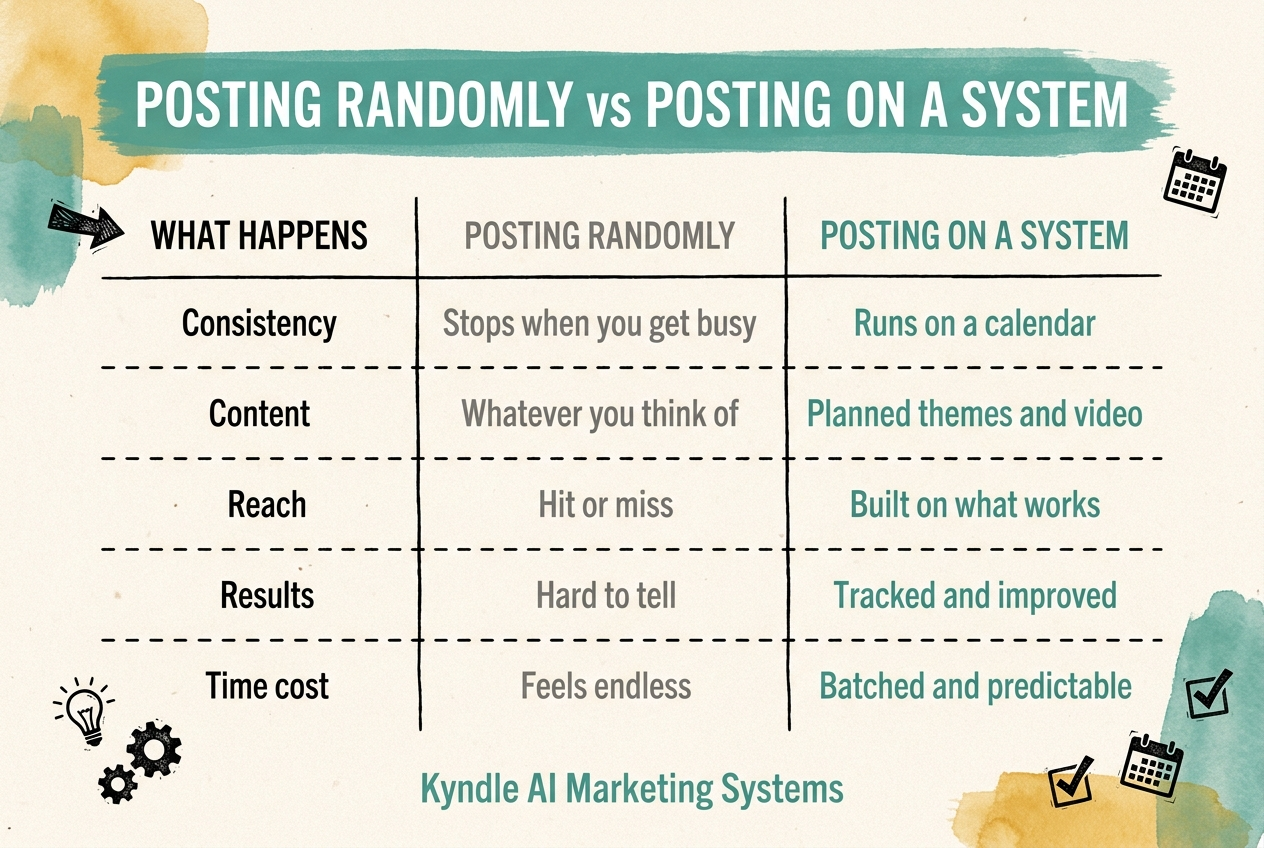
| What happens | Posting by guesswork | Posting on a system |
|---|---|---|
| Consistency | Stops when you get busy | Runs on a calendar |
| Content | Whatever you think of that day | Planned themes and video |
| Reach | Hit or miss | Built on what already works |
| Results | Hard to tell | Tracked and improved |
| Time cost | Feels endless | Batched and predictable |
What tools do you need to manage social media?
You need fewer tools than you think. A small business can run a strong system with three simple categories: a scheduler, a content creator, and an analytics view. Most owners overcomplicate this and end up paying for software they never fully use.
The three tools that matter
- A scheduler: one place to plan and queue posts across your platforms so you are not logging in every day. Many tools offer free plans that cover a single business.
- A content creator: a simple design tool for graphics plus the phone in your pocket for video. You do not need a studio. Clear, well-lit, honest video beats polished and generic.
- An analytics view: the built-in insights on Facebook and Instagram are enough to start. They show reach, engagement, and what your audience responds to.
The newest layer is AI. Modern tools can suggest hooks, draft captions, and turn one idea into several posts. Used well, AI is the difference between a system you can sustain and one that quietly dies the week your schedule fills up. That is exactly where the next section comes in.
The shift that makes it sustainable: AI-assisted content systems
The reason most small business social media fails is sustainability. Doing it all by hand burns out fast. The modern approach uses AI-assisted systems to carry the heavy parts: surfacing data-driven hooks, drafting first versions of captions, and repurposing content so one strong idea becomes a week of posts across platforms. That is how a cadence stays alive even when you are slammed with client work.
This is the difference between “post more” and “post on a system.” We use AI to spot the topics and hooks your audience actually responds to, then repurpose your best-performing content so nothing good gets used once and forgotten. A single customer question can become a video, a carousel, a story, and a written post. The human layer stays human, your voice, your judgment, your relationships, while the system handles the repetitive work that used to eat your evenings.
It is worth being honest about what AI does not do. It does not replace real engagement, genuine expertise, or the trust you build by showing up as yourself. The strongest setup is AI plus a person, not AI instead of one. That balance is what keeps the content both efficient and real.
What does this look like for a Lansing service business?
National advice is fine, but a local service business plays a different game. Your audience is not “anyone, anywhere.” It is people within driving distance who need what you do. That changes the content. Posts that mention your neighborhoods, local landmarks, seasons, and real jobs you have done in the area perform better, because they signal that you are nearby and trustworthy.
Here is a real-world example of the pattern we see again and again. A local contractor posts a quick before-and-after video of a job in a recognizable Lansing neighborhood, answers two or three questions in the comments that afternoon, and within a week has a message from someone two streets over who saw it. That is social media working the way it should for a local business: not viral reach, but the right few hundred local people seeing proof that you do good work nearby. A system makes that repeatable instead of accidental.
Should you do it yourself or hire help?
There is no single right answer. It comes down to your time, your comfort with content, and how much the channel needs to produce. Use the honest trade-offs below.
Doing it yourself makes sense when
- You have a few hours a week you can reliably protect
- You enjoy making content and showing up on camera
- You are early and testing what resonates before investing more
Hiring help makes sense when
- Your calendar is already full and posting keeps slipping
- You want strategy, content, and engagement handled as one system
- You would rather spend your time serving customers than editing videos
If you do decide to bring in a partner, it helps to know what separates a good one from a bad one. We cover the green flags, red flags, and real pricing in our guide on what to look for in social media management services in Lansing.
How much does social media management cost?
Pricing varies with how much you hand off. Doing it yourself costs mainly your time, roughly 8 to 15 hours a month, plus a small tool budget. A freelancer typically runs a few hundred dollars a month for posting and light strategy. A full-service agency that handles strategy, content, video, engagement, and reporting usually starts around the cost of a part-time hire, but without the overhead of an employee.
The honest way to judge cost is by what the channel returns. A cheap setup that posts inconsistently and tracks nothing is not really cheap, because it produces nothing. A system that reliably brings in a few qualified local leads a month pays for itself quickly. We break down the real numbers and what each price should include in our guide on social media management services in Lansing.
How long before social media management brings in leads?
With a real system, most local businesses see better engagement within a few weeks and steady inquiries within a couple of months. It is a build, not a switch, but it does not have to be slow. With a creative social media manager, a single video can take off in your first month and put you in front of your ideal clients right away. At Kyndle, we focus on finding your winning blueprint, the combination of going viral, generating real engagement, and staying consistent. Here is a realistic arc, with room for early wins.
A realistic six-month arc
Foundation and first wins
Set the goal, pick platforms, and build the content system. This is also where early wins happen. With a creative manager, a single video can take off this month and reach your ideal local clients before the system is even fully built.
Traction
Your best content types become clear and you build on any early hits. Comments and direct messages grow, and the first steady inquiries arrive.
Momentum
The loop compounds. You know what works, leads become steadier, and a small paid boost on winners extends reach.
Want to see how this works for your business?
We turn the five-step loop into a done-for-you system, built on AI and tuned for local service businesses in Lansing. Book a free strategy call and we will map it to your goals.
The bottom line
Social media management works when it runs as a loop: strategy, create, schedule, engage, analyze, repeated every month. For a small business, the make-or-break factor is consistency, and the way to protect consistency is a system, ideally one assisted by AI and built around your local market. Get the loop right and your accounts stop being a chore and start bringing in leads. When you are ready to compare doing it yourself with hiring help, see our guide on what to look for in social media management services in Lansing, or read why some accounts stall in why your business isn’t getting leads from social media.
What does a social media manager do?
How many hours a month does social media management take?
How often should a small business post on social media?
Which platforms should a local business focus on?
Can AI run my social media for me?
How long before social media brings in leads?